

Laboratory Services: Climate Lab
NAF Climate Lab: weather forecasts and agro-advisories
Village-level weather observation, five-day forecasting and crop-specific agro-advisories for farmers across Tamil Nadu, Karnataka and Maharashtra, from a sensor in a field to a decision on a farm.
Climate Lab
From a sensor in a field to a decision on a farm.
The NAF Climate Lab is best understood not as a weather station but as an agricultural decision-support system built on one, shortening the distance between what the atmosphere is about to do and what a farmer decides to do about it.

The climate-science and digital-agriculture arm of the National Agro Foundation, it brings real-time weather observation, numerical weather prediction, agrometeorological analysis, agricultural water management, climate-risk assessment, digital advisory services and farmer capacity building together under a single operational framework.
- Registered farmers, all reached by advisory
- 5,140
- Automatic Weather Stations
- 28
- States: Tamil Nadu, Karnataka, Maharashtra
- 3
- Districts covered by advisory
- 9
- Registered crop types
- 27
- Active crop entries
- 234
- Weather and agromet parameters forecast
- 18
- Advisory messages sent via mobile (SMS)
- 44.24 L+
Vision
A scientifically robust and farmer-centred climate-intelligence system that enables timely, location-specific and actionable decisions for climate-resilient agriculture and sustainable natural-resource management, placing climate science, weather intelligence and digital agricultural technology at the direct service of farmers, not as a research output confined to a laboratory or dashboard, but as a working input to everyday farm decisions.
Mission
- Generate reliable, localized weather information through continuous ground-based observation
- Integrate observations with numerical weather forecasts to extend the planning horizon beyond the present moment
- Translate weather information into agrometeorological intelligence: crop-water, soil, heat and disease-risk indicators
- Provide crop- and location-specific advisories rather than generic district-level bulletins
- Improve agricultural water-use efficiency through evapotranspiration-based irrigation guidance
- Support climate-risk preparedness and early warning for rainfall, heat, wind and dry-spell hazards
- Enable digital delivery of climate information across SMS, chat, mobile application, web and display-board channels
- Build farmer capacity in climate-resilient agricultural practice
- Generate scientific evidence and long-term datasets for climate adaptation research
- Develop and demonstrate climate-smart technologies, including smart irrigation
Core initiatives
Forecasting
Five-day forecasting,village by village
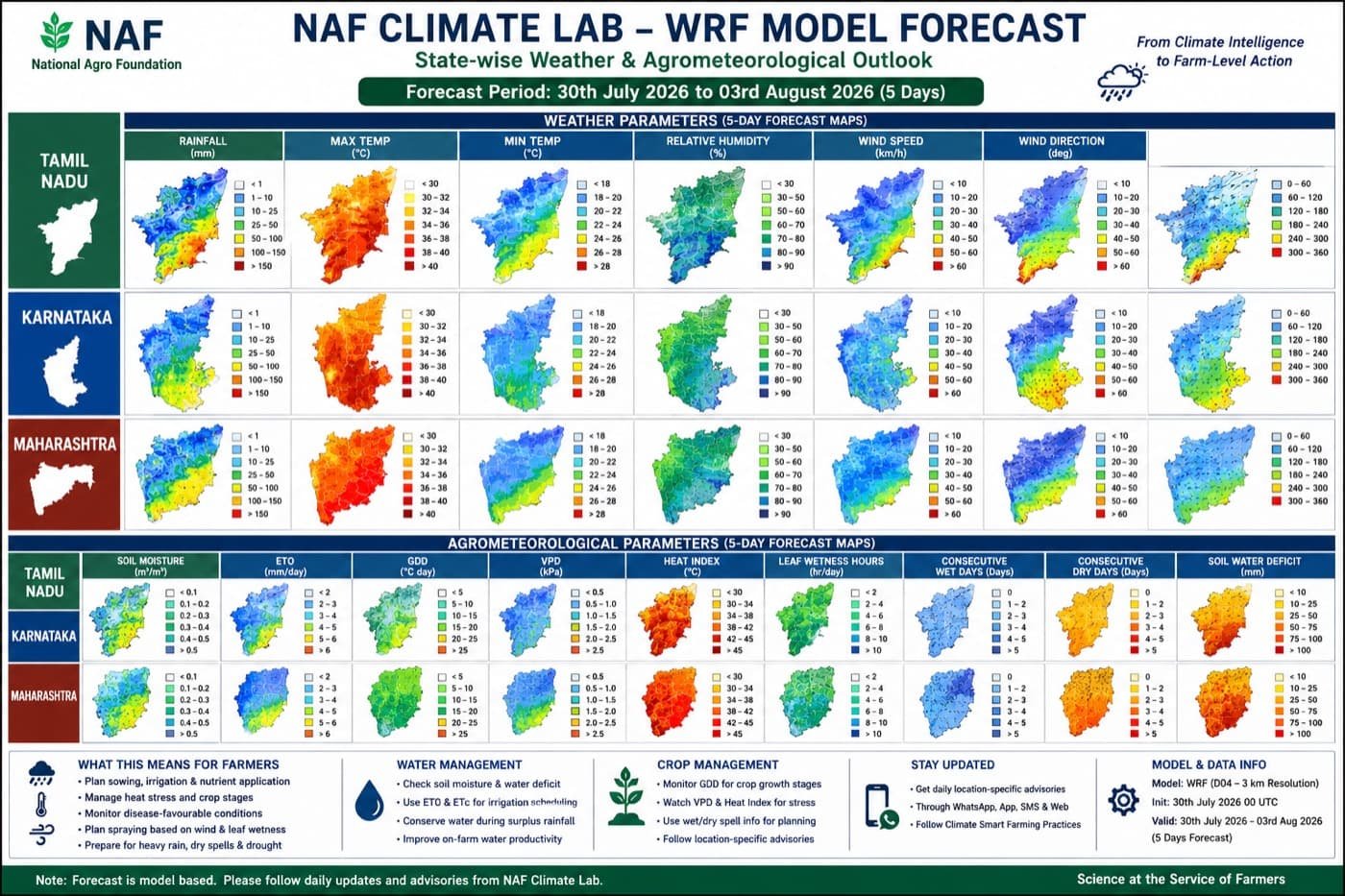
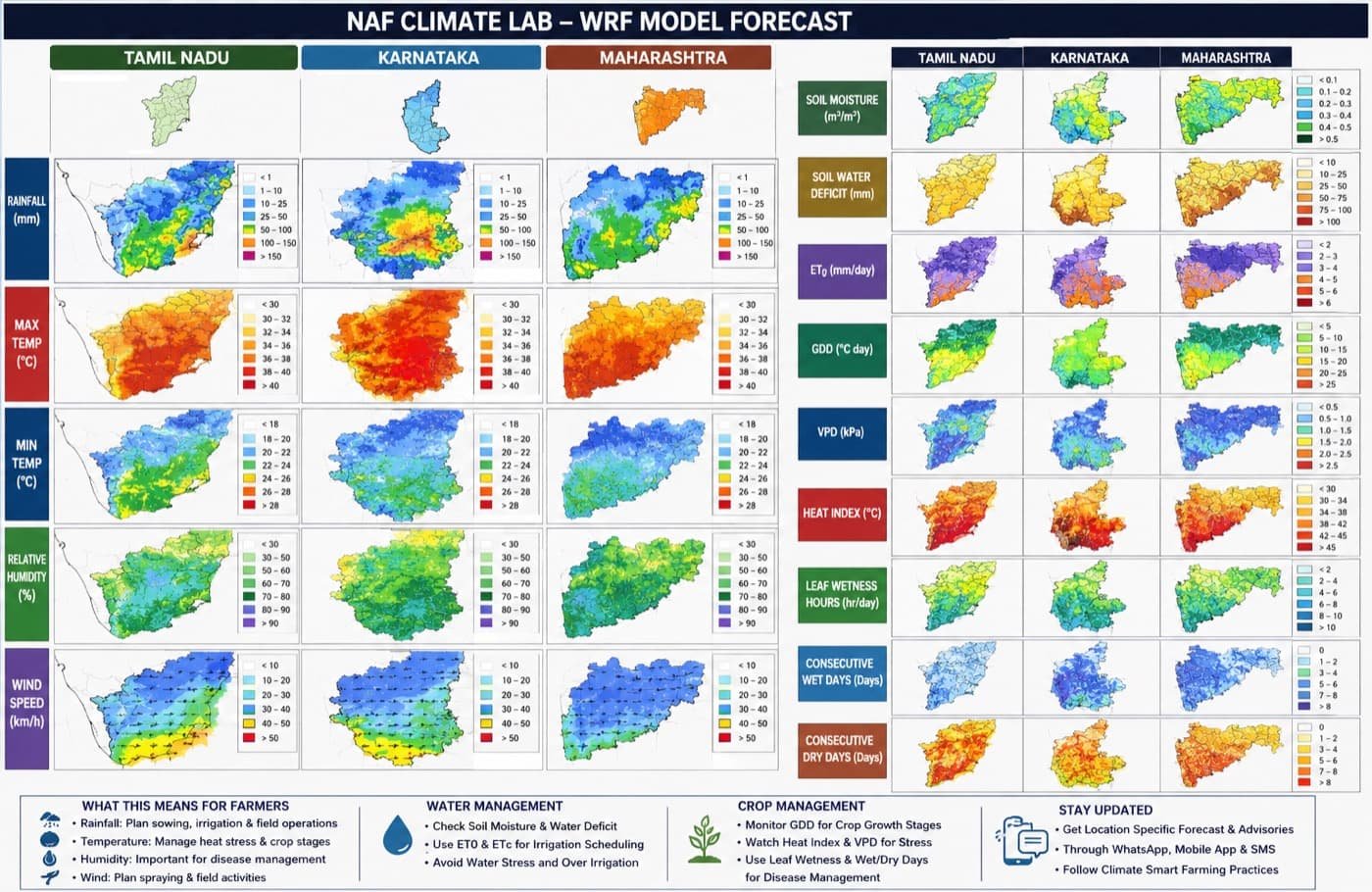
The Lab runs the WRF (Weather Research and Forecasting) numerical model, a research-grade, operational weather-prediction system, across three nested forecast domains: Tamil Nadu and adjoining regions, the Maharashtra region, and Karnataka and adjoining regions. Each domain produces a five-day forecast sequence, rendered as georeferenced spatial maps, for eighteen weather and agrometeorological parameters.
Coverage is reported per daily run, not summed across the five forecast days. The Lab regenerates a fresh five-day forecast for the same 46,069 villages every day, so counting cumulatively would repeat the same villages five times over and overstate the reach.
Every run resolves conditions down to individual village level, not just district level. The most recent daily run generated forecast values for 46,069 named villages, spanning 474 blocks and 73 districts across Tamil Nadu, Karnataka and Maharashtra, for all eighteen parameters.
- 46,069
- Villages forecast in the daily run
- 474
- Blocks covered
- 73
- Districts covered
- 3
- States / forecast domains
- 5
- Forecast days per run
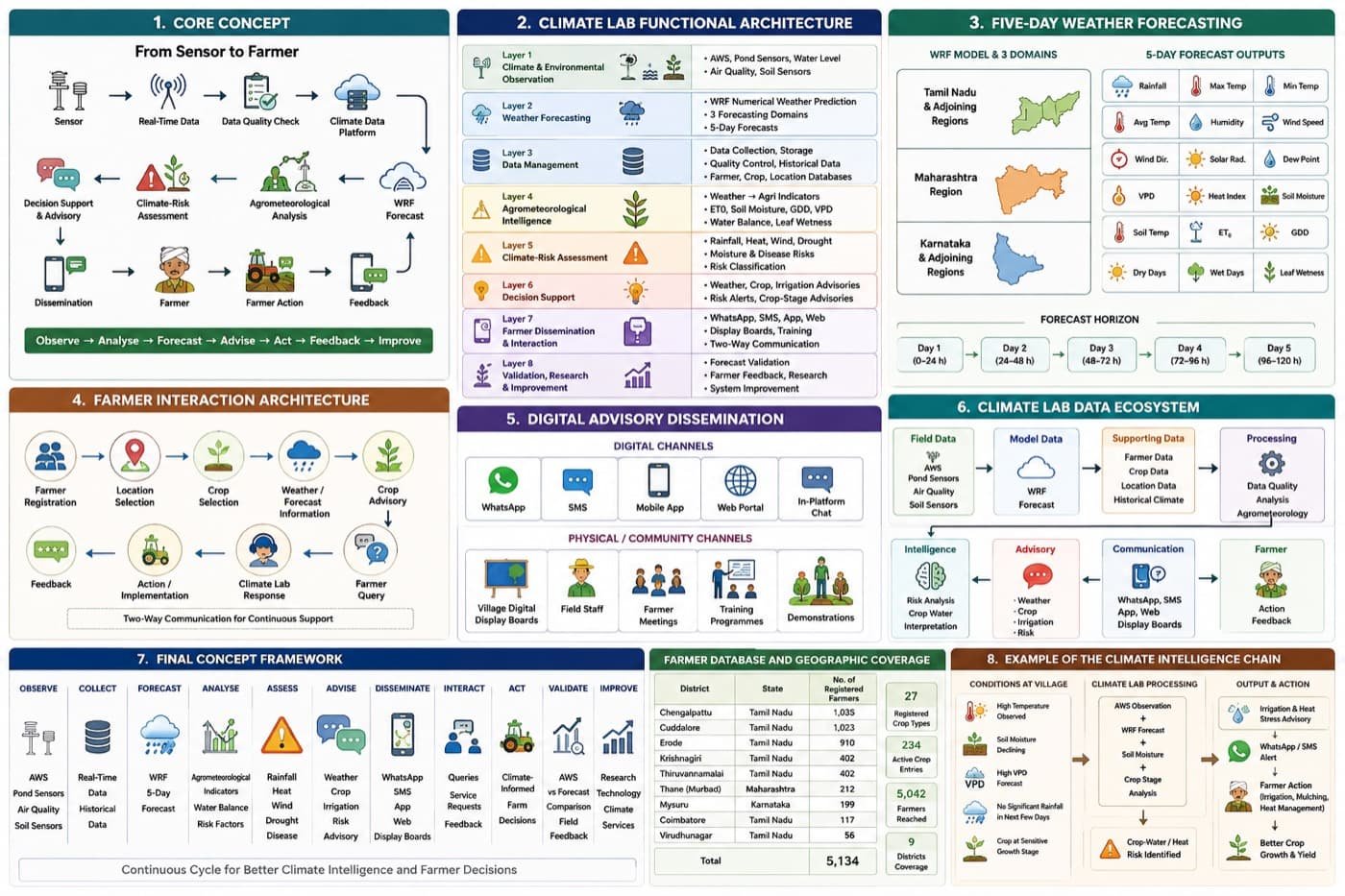
Eight functional layers
How the Lab is organised, from the sensor upward.
Observation
AWS, pond and air-quality sensors
Forecasting
WRF numerical weather prediction
Data management
Ingestion, quality control and storage
Agrometeorological analysis
Derived indicators: ET0, GDD, VPD and others
Risk assessment
Heat, rainfall, drought and wind
Decision support
Decision support and advisory
Dissemination
Dissemination and farmer engagement
Monitoring
Monitoring, validation and research
The eighteen parameters
- Rainfall
- Maximum and minimum temperature
- Average temperature
- Relative humidity
- Wind speed and direction
- Solar radiation
- Dew point
- Vapour pressure deficit
- Heat index
- Soil moisture
- Soil temperature
- Soil-water deficit
- Reference evapotranspiration (ET0)
- Growing degree days (GDD)
- Consecutive dry and wet day counts
- Leaf wetness duration
Technology in action
“What is happening right now, at this specific village?”
Each Automatic Weather Station reports live temperature, humidity, wind speed and direction, rainfall, solar radiation and barometric pressure (and, where fitted, soil moisture and soil temperature) to the Climate Monitoring Portal. That is what answers the question, and it is what every forecast is checked against.
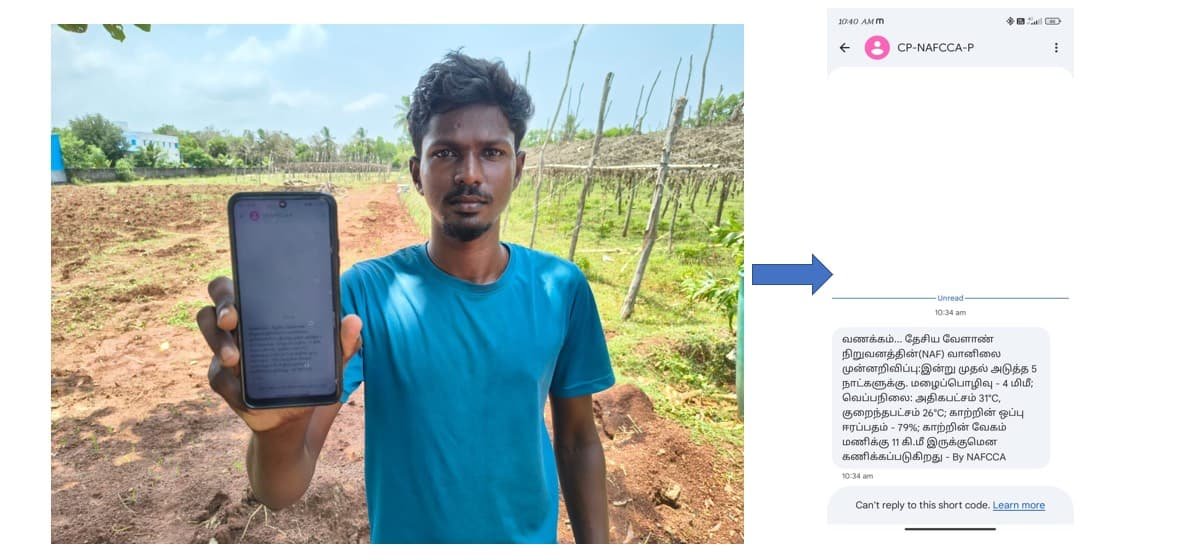
The information then reaches farmers directly on their own phones. A farmer in the field receives a short forecast message (rainfall, temperature range, humidity and wind speed for the coming days) sent by the Climate Lab through SMS, in their own language, at no cost to them.
What the forecast tells a farmer to do
- Rainfall
- Plan sowing, irrigation and field operations
- Temperature
- Manage heat stress and crop stages
- Relative humidity
- Important for disease management
- Wind speed and direction
- Plan spraying and field activity
- Soil moisture and water deficit
- Schedule irrigation, avoid over-watering
How advisories reach farmers
Advisories go out every Tuesday and Friday in Tamil, Kannada and Hindi. More than 44.24 lakh messages have been sent to farmers' mobile numbers to date.
Digital
- SMS
- Mobile app
- Web portal
- In-platform chat
Physical and community
- Village digital display boards
- Field staff visits
- Farmer meetings
- Training programmes
- Field demonstrations
Our footprint
Weather-based agro-advisories are dispatched every Tuesday and Friday in Tamil, Kannada and Hindi, through SMS, the mobile application and the NAF weather portal. More than 44.24 lakh advisory messages have been sent to farmers' mobile numbers to date, reaching farmers across these districts.
- ChengalpattuTamil Nadu
- CuddaloreTamil Nadu
- ErodeTamil Nadu
- KrishnagiriTamil Nadu
- ThiruvannamalaiTamil Nadu
- CoimbatoreTamil Nadu
- VirudhunagarTamil Nadu
- Thane (Murbad)Maharashtra
- MysuruKarnataka
How the Lab works
From a sensor in a field to a decision on a farm, in nine stages.
The Climate Lab runs one continuous cycle. A reading taken in a village becomes a specific, timely instruction a farmer can act on, in their own language, on their own phone, and what actually happened then feeds back into the next forecast.
- 01
Observe
Automatic Weather Stations, pond sensors and air-quality units report temperature, humidity, wind, rainfall, solar radiation, pressure and soil condition from the village itself.
- 02
Forecast
A daily Weather Research and Forecasting model run extends the picture five days ahead across three nested domains covering Tamil Nadu, Karnataka and Maharashtra.
- 03
Analyse
Readings and forecasts are ingested, quality-controlled and turned into agrometeorological indicators: reference evapotranspiration, growing degree days, vapour pressure deficit and the rest.
- 04
Assess
Those indicators are scored as risk: heat stress, rainfall and dry spells, drought and wind, at the location and crop stage they apply to.
- 05
Advise
Risk becomes guidance. Each farmer's crop, sowing date and soil are combined with their village forecast to produce a specific advisory rather than a district bulletin.
- 06
Disseminate
Advisories go out twice a week in Tamil, Kannada and Hindi over SMS, WhatsApp, the mobile app, the web portal and village LED display boards.
- 07
Act
The farmer sows, sprays, irrigates or holds off on the day the weather actually supports it, at no cost for the information.
- 08
Monitor
The forecast is checked back against what the stations recorded, so the Lab knows where it was right and where it was not.
- 09
Improve
Validation feeds the next model run and builds the long-term dataset behind the Lab's climate adaptation research.
Climate Lab enquiries
Talk to the NAF Climate Lab.
For village-level forecasts, agro-advisories or weather-station data, get in touch with the Laboratory Services Division.
Whether you are a farmer, an FPO, an agricultural institution, a researcher, an industry, a student or a project organisation, the Laboratory Services Division can support your analytical requirements with quality-assured testing services. Get in touch for sample submission, testing requirements and further enquiries.
Email about the Climate LabReliable testing. Scientific analysis. Sustainable solutions.